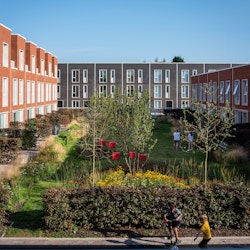
Born in Bray
Sea Gardens is an emerging coastal neighbourhood born from local roots.

A playful resort
Bray was once the coastal resort for Dubliners looking to escape the city. Today, it is still a relaxed, nature-oriented resort town, distinct from the capital in character and pace. It remains a place centred on leisure rather than work, celebrated for its arts and music scene, sea swimming and surfing, and ready access to the Wicklow Mountains.
Our approach to Sea Gardens consciously builds on and continues the irregular and grown-in character of this 19th-century resort town. Extending over 16 hectares (40 acres), the growing neighbourhood features 1,200 new homes alongside shops and cafes with a Market Square providing a focal point for the community and hosting food markets, festivals, and exhibitions.
-

![Illustrative masterplan]()
Illustrative masterplan
-

![Bray Context]()
-

![Bray promenade circa. 1900]()
Bray promenade circa. 1900

A seamless extension of Bray
Landscape led
To create a place that felt like a seamless extension of Bray, our first move was to establish a vocabulary of streets, squares, and parks that could knit into the town’s streetscape and its network of walkable routes. Homeowners at Sea Gardens can enjoy access to pedestrian routes running north-south along the coast to Bray Head and east-west along the river, connecting to the town centre.
Due to be delivered in distinct phases, the neighbourhood is tied together using a landscape palette of light stone, coastal grasses, and indigenous trees, particularly Scots Pine, characteristic of this part of Ireland. Throughout the district, public green space is interwoven and includes a new two-hectare Central Park along the river that retains existing trees and will provide flood defence for the town.


Quiet, crafted and local
Buildings at Sea Gardens feel both familiar and new. Throughout, we’ve selected materials that continue the town’s 19th-century architectural palette of colour and materials, with render used for more modest buildings and brick for larger ones.
Our intervention tunes into the local character, and we worked “small to big,”
As part of the initial phase, we introduced a collection of calm, understated homes designed to meet local needs. The mix of two- and three-storey houses, duplexes and medium-density apartment buildings includes a distinctive ‘over-and-under’ house typology where a two-storey home sits above a single-storey garden home.


This layered mix supports a vibrant blend of families, young professionals, downsizers and single residents—shaping a new neighbourhood that enriches daily life and feels genuinely communal. Typical of seaside resorts, future phases will feature taller elements along the seafront, creating grandeur and enclosure, while two and three-storey homes sit further inland, consistent with the existing townscape.

Cross section through the 'over and under' house

Illustrative view showing future phases
| Client | Ballymore | |||||
|---|---|---|---|---|---|---|
| Location | Bray, Co. Wicklow | |||||
| Size | 21.3 hectares | |||||
| Status | Current | |||||
| Homes | 1,200 homes | |||||
| Team |

|

|

|

|

|
Wiktoria Piotrowska |