From Farm to Farm
A new generation of motorway services, Tatton Services’ landscape-led architecture embeds facilities for travellers firmly within an age-old agricultural setting, while creating opportunities and lasting value for its surrounding communities.

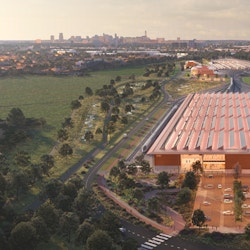
Illustrative aerial view
People and place
“Place, particularly in rural communities, has always been everything,” says Sarah Dunning of the Westmorland Family, who opened Tebay Services, the UK's first alternative-model motorway service station, on the family's Cumbrian farm back in 1972.
Today, the family-run sustainable business operates multiple sites across the UK. Their business model remains one of sourcing from local farmers and food producers, creating long-term local employment, enduring community partnerships, and architecture that is sustainable and sensitive to its environment.
Building on our long-standing partnership with Westmorland, we’ve secured consent for their next addition to the motorway network, Tatton Services—embedding facilities for road travellers firmly within an age-old agricultural setting.

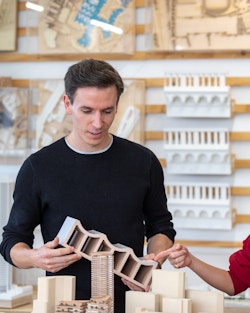
1:1000 concept model
A 21st-century design challenge
Looking ahead to a post-fossil fuel UK, Westmorland and venture partner Tatton Estates turned to us to unlock permission for a complex site comprising disused farmland encircled by motorway (M56) and road infrastructure (A566). Tackling such a sensitive site required careful engagement with key consultees, including the National Trust, HS2, Cheshire Wildlife, and Manchester Airport.
Our concept synthesises landscape, architecture, and place. We’ve sought to unite the site’s original farmhouse and farmyard with a contemporary rural vernacular of low-lying timber-framed buildings, expressed in natural materials. To minimise embodied carbon, buildings are oriented to the south-west to maximise solar generation, with extensive photovoltaic arrays integrated into roofs pitched at 30-degree angles.
To help shape what might otherwise be exposed road infrastructure into a calm rural setting, we’re adopting a balanced cut-and-fill strategy. Mounding bordering the periphery of the site instils a sense of enclosure via visual screening and acoustic protection. Carefully designed ponds, swales and planted areas are positioned throughout the landscape to slow and filter rainwater across the site, creating new habitats for wildlife.

1:250 model
A visitor experience
Visitors to Tatton Services will not arrive at a typical motorway forecourt but into a tranquil, landscaped environment that feels deliberately removed from the motorway. The arrival sequence allows drivers or cyclists time to orient themselves, and either make a quick pit-stop at the fuel barn or stop to explore Tatton’s farm shop, food halls and kitchen garden, where the emphasis is firmly on locally sourced produce.
-

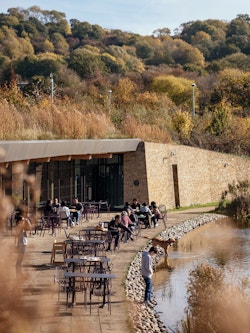
![Dining area]()
Dining area
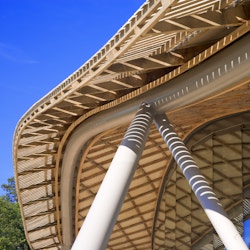
With a clearly articulated structural logic and familiar vernacular, the main farm shop and food hall building provides shelter beneath a carefully proportioned gabled roofscape. Externally, glazed gable ends are shaded by deep overhanging eaves and vertical timber brise-soleil, adding depth and texture to the façade. Internally, a series of vaulted timber roof structures spans the main hall, their structural rhythm defining the interior space.
Tatton Services feels less like roadside infrastructure and more like a contemporary farmstead: a place where landscape, architecture and food culture come together to create a meaningful stop within the journey.

| Client | Westmorland and Tatton Estates | |||||
|---|---|---|---|---|---|---|
| Location | Tatton, Cheshire | |||||
| Size | Site area – 15.8 ha; Amenity building – 5,180 sq m; Fuel barn – 910 sq m | |||||
| Status | Current | |||||
| Team |

|
|

|
Eliza Benson | Max Worrall |
|